OT security: protect the process before probing devices
OT security must account for physical processes, safety, availability and engineering constraints. Use the final NIST SP 800-82 Rev. 3 as a reference; a later draft is not a final replacement. IT scanning assumptions cannot be transferred blindly to controllers and safety-related systems.
SecNet learning series · 1.0 · Source check: 2026-10-11Original SecNet educational content. Examples are fictional; this is not a publication or endorsement by the referenced organizations.

Factory · IT / OT zones and conduits
See boundary controls around a factory’s operational network.
OT data reaches a monitored DMZ service. Enterprise applications consume brokered data; no direct IT-to-PLC session.
Show process diagram
How to plan and execute
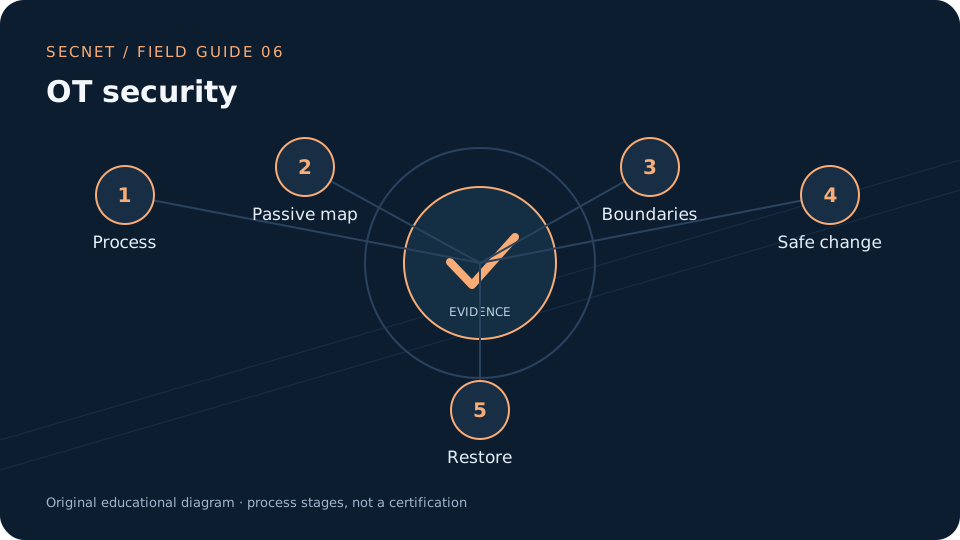
- Form a joint operations, engineering, safety and security team. Identify critical process states and agree who may stop an activity when plant behavior changes.
- Build an asset and dependency map from engineering records and passive observation. Record controller/firmware versions, unsupported systems and the confidence of the inventory.
- Define process zones and constrained communication paths. Separate vendor remote access with approval, time limits, logging and a recovery method suitable for operations.
- Assess proposed tests with engineering and suppliers in a representative lab first. Prefer passive evidence; active tests need explicit validation, a maintenance window and a stop/rollback plan.
- Treat patching as controlled engineering change. Where a patch cannot safely be applied, document compensating controls, residual risk, review date and accountable acceptance.
- Exercise recovery of engineering workstations, logic/configuration backups and approved spare devices. Coordinate cyber response with plant emergency procedures and physical safety.
Tools & work records
- Engineering inventory and passive telemetry — start with existing records and permitted mirror/TAP observations; validate protocol coverage.
- Wireshark — protocol evidence where approved; packet capture access and retention still need control.
- Lab and restore worksheets — record representative hardware, vendor approval, stop thresholds and demonstrated recovery.
What reports are produced?
- Process-critical asset map and safety/change constraints.
- Zone/communication review and remote-access control record.
- Compensating-control register and tested restoration plan.
Connect the decision to evidence
Fictional plant: an older controller has a known weakness but no validated patch. The team does not launch an IT scanner at it. They review vendor guidance, narrow reachable services, restrict remote maintenance and test a representative spare in the lab. The risk record names the process owner and next review, while the restore exercise proves that backed-up logic can be recovered.
Closure check
- Operations and safety owners approve the plan?
- Active tests validated in a representative lab first?
- Logic/configuration restoration demonstrated?
Official sources
Use these sources for criteria, tools and regulations; verify applicability and version for the actual assessment.