Network security: design boundaries you can verify
Network assurance starts with business flows and identities, not a firewall product list. Maintain a map of intended communication and test whether boundaries enforce it. The workflow below uses NIST assessment guidance and original segmentation exercises; packet capture and active discovery require authorized scope.
SecNet learning series · 1.0 · Source check: 2026-10-11Original SecNet educational content. Examples are fictional; this is not a publication or endorsement by the referenced organizations.

Network · firewall boundaries
Different flows need different rules. Trace the example routes across trust boundaries.
Example rule: Internet → public web on TCP 443. It does not expose the database.
Show process diagram
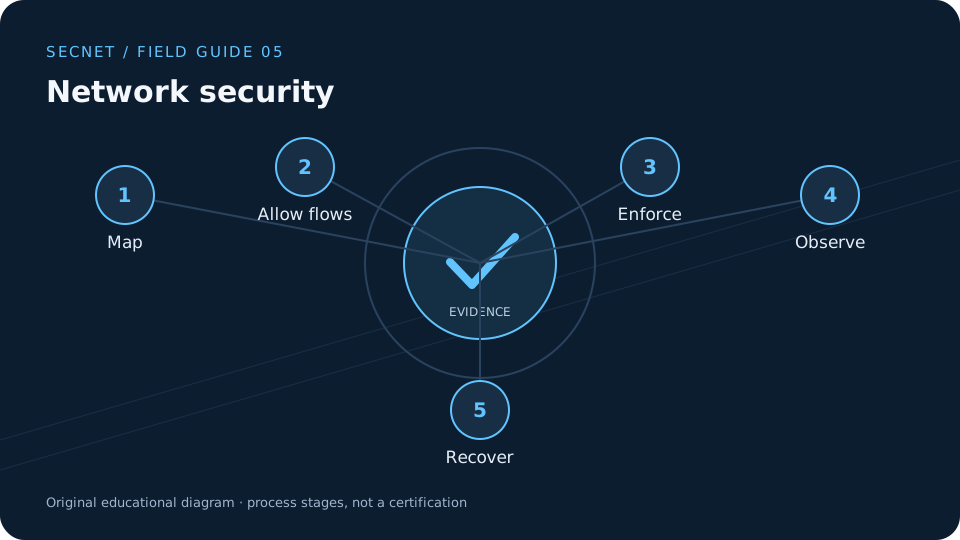
How to plan and execute
- Inventory assets, routes, identity systems, remote access and critical dependencies. Include cloud peering and management networks, not only office subnets.
- Create an allowed-flow matrix: source zone, destination zone, service, identity, business owner and expiry. Remove rules without a justified purpose through change control.
- Separate user, server, management and external paths according to risk. Restrict administrative access and document how emergency access is granted and reviewed.
- Verify representative permitted and denied flows during an approved window. Capture the vantage point and topology version; one blocked ping is not proof of application isolation.
- Correlate network telemetry with identities and response ownership. Tune actionable signals and retention rather than collecting payloads without a defined investigation use.
- Exercise failover, backup restoration and rollback of network changes. Review stale access after incidents, supplier changes and major architecture updates.
Tools & work records
- Nmap — approved service discovery; results describe the tested vantage point and time, not every possible network path.
- Wireshark — selected protocol/capture evidence with payload minimization and authorized access.
- Zeek / Suricata — network visibility and detection respectively; validate alert routing and analyst response with a permitted exercise.
What reports are produced?
- Current topology and allowed-flow matrix with owners.
- Segmentation test record including both allowed and denied cases.
- Detection/response exercise and network change rollback record.
Connect the decision to evidence
Fictional exercise: a contractor zone should reach a maintenance portal but not server administration. Test both intended paths from a contractor test endpoint. Record application-level results and rule references; repeat after a rule change. A test from an administrator laptop would use the wrong vantage point and could produce false assurance.
Closure check
- Every rule has a business owner and purpose?
- Both permitted and denied paths tested?
- Telemetry reaches an accountable response team?
Official sources
Use these sources for criteria, tools and regulations; verify applicability and version for the actual assessment.