Cross-border data: map the transfer before choosing a mechanism
Personal-data transfers need their own jurisdictional analysis; they are not resolved by an export license or a vendor contract alone. EU Commission SCCs and EDPB Recommendations 01/2020 are references for relevant GDPR transfers. Do not apply the EU model automatically to UK, Turkish or other legal regimes.
SecNet learning series · 1.0 · Source check: 2026-10-11Original SecNet educational content. Examples are fictional; this is not a publication or endorsement by the referenced organizations.

Cross-border data · map, assess, then decide
This is a transfer-review workflow, not a live data transfer. Select an example and inspect each labelled stage. Playback starts only when you choose Play.
Follow the evidence from sender to the owner’s decision. Each stage is a review task, not proof that a transfer is lawful.
Record categories, purpose and sender role; use fictional or redacted examples.
Show process diagram
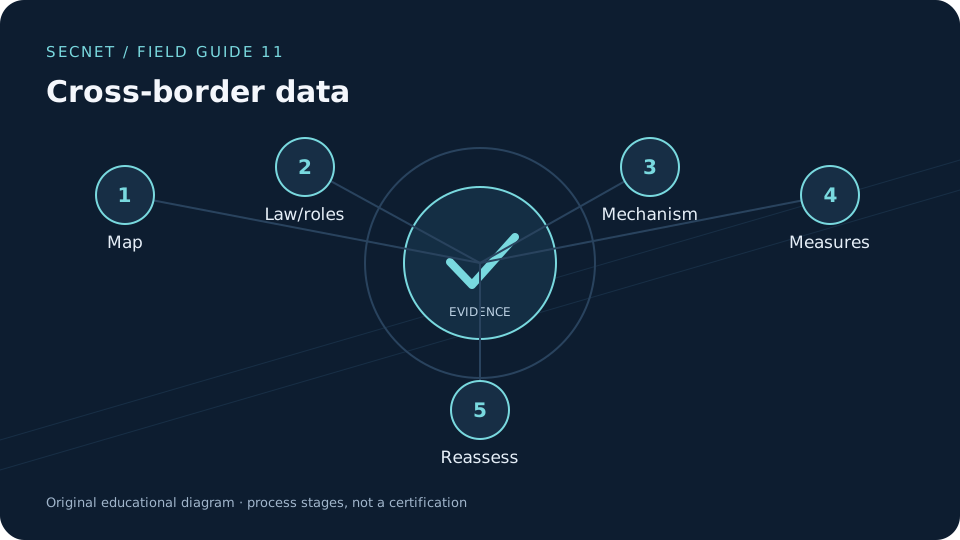
How to plan and execute
- Map personal-data categories, exporter/importer roles, storage, remote access, onward recipients and purpose. Include support access and backups, not just the primary hosting region.
- Identify applicable privacy laws and whether the activity is a regulated international transfer. Ask the privacy/legal owner to validate scope and lawful processing separately.
- For relevant GDPR transfers, evaluate the available transfer mechanism, such as an applicable adequacy decision or appropriate safeguards. Document the actual conditions rather than using a generic SCC label.
- If using SCCs, select suitable modules and assess the transfer circumstances and destination-law risks. Distinguish international-transfer SCCs from controller/processor clauses for another purpose.
- Evaluate necessary supplementary measures and their effectiveness: minimization, key control, access boundaries and contractual/organizational safeguards. Encryption is not decisive when the recipient needs plaintext.
- Record approval, retention, onward-transfer restrictions and reassessment triggers. Test whether real technical access matches the approved transfer map.
Tools & work records
- Data-flow inventory — roles, countries, categories, purpose and remote-access paths with verified owners.
- Transfer assessment worksheet — mechanism, destination circumstances, measures and unresolved legal questions.
- Access/key evidence — technical proof of who can decrypt or retrieve data, not only an architectural promise.
What reports are produced?
- Transfer inventory and jurisdiction/role analysis.
- Mechanism selection and transfer/supplementary-measure assessment.
- Approval, technical verification and periodic reassessment record.
Connect the decision to evidence
Fictional service: customer records stay in an EU region, but a support team elsewhere can view them. The team maps that access, minimizes the support fields and evaluates the applicable transfer route with its privacy owner. “EU hosting” is not treated as proof that no international access exists; the access logs and support permissions are checked against the agreed design.
Closure check
- Remote support and onward recipients included?
- Mechanism and roles reviewed for the actual jurisdiction?
- Technical measures verified and review triggers set?
Official sources
Use these sources for criteria, tools and regulations; verify applicability and version for the actual assessment.